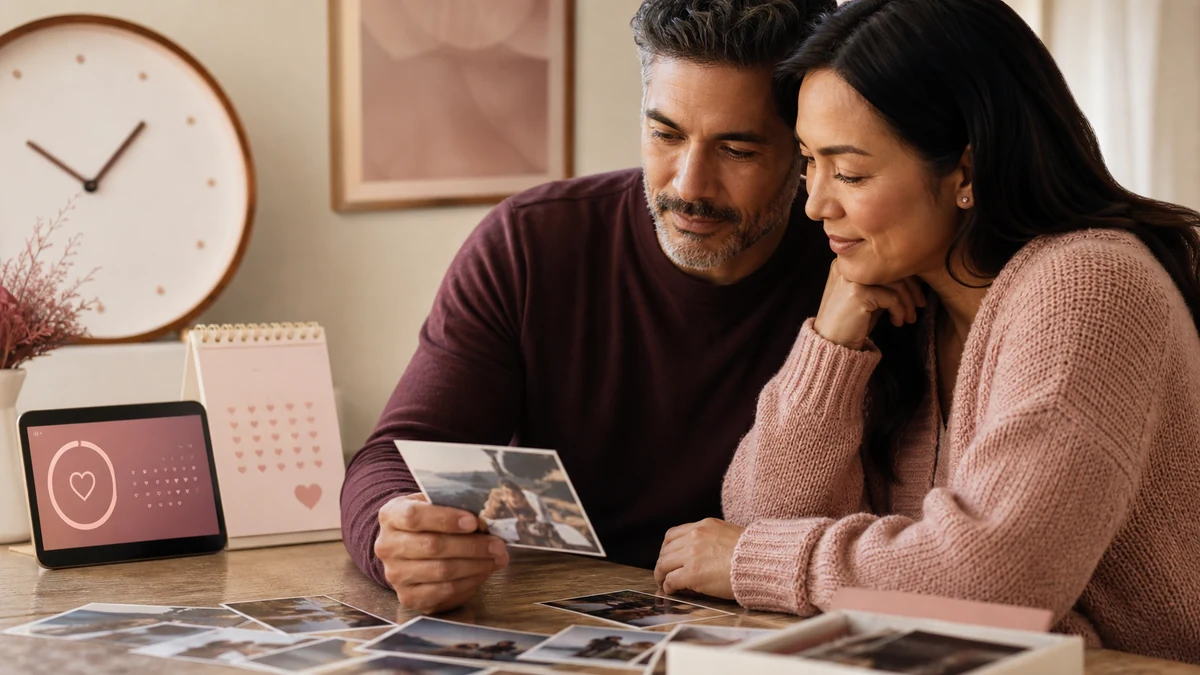
A Love Counter gives you a number. But what does that number actually mean? Is measuring your time in love just a novelty, or is there something deeper in watching the days accumulate? This thoughtful look explores why counting your time together resonates so strongly, and what those figures really represent.
Key Takeaways
- Time in love is one of the few things a relationship reliably accumulates.
- Seeing it counted makes an abstract feeling concrete and visible.
- Different units frame the same time in emotionally different ways.
- The number matters because of the meaning you attach to it.
Making an Abstract Feeling Concrete
Love is famously hard to measure. We cannot quantify how much we care or weigh the depth of a bond. But time is one dimension of a relationship we can capture precisely. When a Love Counter turns your months and years into a live number, it makes something abstract suddenly concrete. You can see your commitment, expressed in the steady accumulation of days. That visibility is quietly powerful.
What Your Time Together Represents
Every day on your counter stands for something real: a day you chose each other, weathered together, or simply spent side by side. The number is not just arithmetic. It is a tally of shared mornings, resolved arguments, ordinary evenings, and small kindnesses. When you look at it that way, a large day count becomes genuinely moving, a record of everything you have built. Our guide to tracking your relationship explores how to honor that record.
How the Framing Changes the Feeling
One of the most interesting things about a Love Counter is how different units evoke different emotions. "Two years" sounds tidy and factual. "730 days" sounds like an accomplishment. "Over 17,000 hours together" sounds almost staggering. The underlying time is identical, yet each framing lands differently. That is not a trick. It is a reminder that how we describe our time shapes how we value it.
The same span of love can feel modest or magnificent depending only on the unit you choose to see it in.
Milestones as Meaning-Makers
Numbers become especially meaningful at milestones. There is nothing objectively special about day 1,000 versus day 999, yet crossing it feels significant. That is because we invest round numbers and anniversaries with meaning, using them as prompts to pause and reflect. A Love Counter simply surfaces these moments so you do not miss the chance. Our guide to relationship milestones shows how to make the most of them.
Time Is Not a Competition
It is worth saying clearly: more time is not inherently better, and a relationship's worth is not measured by its length. A new couple's fifty days can hold as much love as another's fifty years. The counter is not a scoreboard. It is a mirror that reflects your particular story back to you. Held in that spirit, the number is a source of warmth rather than comparison.
Why the Number Matters
Ultimately, your time in love matters because of the meaning you bring to it. On its own, a counter is just software doing subtraction. What makes it meaningful is you: your memories, your gratitude, your choice to notice and celebrate the passage of time together. The number is a doorway. What lies beyond it is your whole relationship. Open the Love Counter, watch your time in love add up, and let it remind you of everything those days represent.
Start Counting Your Days in Love
Turn your special date into a live count you will treasure. Free, private, and ready in seconds.
Frequently Asked Questions
It represents the accumulated days you have chosen to spend together, each standing for shared experiences. A Love Counter makes that abstract commitment visible and concrete.
Framing changes feeling. Two years, 730 days, and 17,000 hours describe the same span, but each lands differently, reminding us that how we describe time shapes how we value it.
No. A relationship's worth is not measured by its length. A Love Counter is a mirror of your particular story, not a scoreboard for comparison.